When Eschatology Meets Power, Wisdom Must Draw a Line
Created on: 8th April 2026
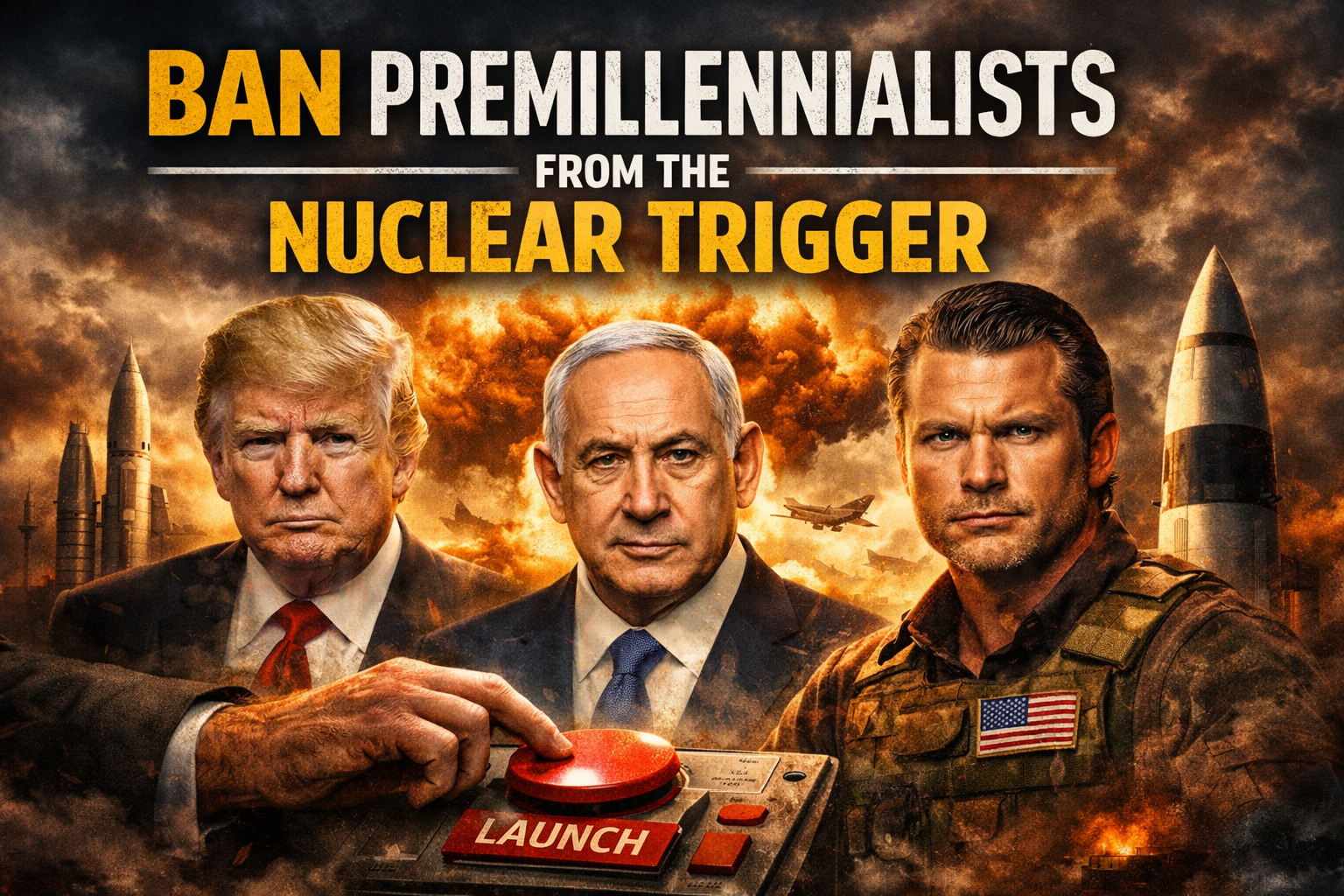
Why No Premillennialist Should Ever Be Allowed Near the Nuclear Trigger
When Eschatology Meets Power, Wisdom Must Draw a Line
By Reverend Veril Richardson Farquhar
I hold, without apology, to the verbal plenary inspiration of Holy Scripture—that the Bible is God-breathed in its entirety, to be taken seriously where it speaks plainly, and handled with reverent care where it speaks in symbol and vision. I take the text as it stands, and it is precisely this commitment that leads me to a deeply uncomfortable conclusion.
I am a premillennial, pre-wrath rapture Christian. And because I am, I must say this plainly: no premillennialist should ever be entrusted with the instruments of ultimate war. Not because such men are wicked. But because they are human. And the temptation—given their framework—is too great.
We are witnessing, in real time, the troubling convergence of theology and geopolitical ambition. Language once confined to the pulpit—Armageddon, end times, final battle—is increasingly echoed in political discourse, media commentary, and strategic rhetoric surrounding global conflict, particularly in relation to Israel, Iran, and American evangelical support for maximalist policies.[1][2]
Observers have long noted how strands of evangelical thought interpret modern geopolitical events through the lens of biblical prophecy, especially those tied to the return of Christ and the role of Israel in eschatological timelines. Pew has repeatedly found white evangelical Protestants among the American religious groups most favourable toward Israel, while reporting in The Guardian has described a current within evangelical theology that sees Jewish return to the land as prophetically significant.[2][3][4]
The concern is not abstract. In March 2026, The Guardian reported that the Military Religious Freedom Foundation said it had received more than 200 complaints from U.S. service members alleging that commanders or chaplains had used end-times Christian rhetoric to frame the Iran war as part of God's plan.[1] Whatever one makes of every allegation, the very existence of such claims should alarm any serious Christian. A constitutional military is not a prophecy engine.
Let me be clear: this is not an attack on all theological positions. It is a warning directed at a specific danger—one I myself am not exempt from. Premillennial theology, taken seriously, teaches that history is moving toward a defined and dramatic divine intervention. That belief, held properly, should produce humility. But in the wrong hands, under pressure, it can produce something else: the quiet notion that one might somehow participate in bringing that end about.
And that is where the danger lies.
The Lord Jesus Christ settled this matter with absolute clarity: “But of that day and hour knoweth no man, no, not the angels of heaven, but my Father only” (Matthew 24:36, KJV). No president, no general, and no strategist may claim authority over the timetable of God. The return of Christ is not triggered by conflict. It is not advanced by policy. It is not hastened by war. It is commanded by the Father alone.
Whether one believes the Book of Revelation or not, its imagery has entered the bloodstream of modern culture. And what enters the imagination can be used. Apocalyptic language—beasts, battles, final reckonings—can be repurposed as a narrative framework through which conflict is interpreted and justified. Political actors, ideologues, and strategists may not believe the text in a theological sense, but they understand its power. If a population can be persuaded that events are inevitable, resistance weakens. If conflict can be framed as destined, moral hesitation diminishes. And if war can be clothed in the language of divine fulfilment, then it becomes something far more dangerous than policy. It becomes purpose.
This concern is magnified when statecraft and prophecy language bleed together. In February 2026, Forward reported on comments by Mike Huckabee, then U.S. ambassador to Israel, after an interview with Tucker Carlson in which he rooted expansive territorial claims in biblical language; the article argued that the exchange illustrated how explicitly Christian Zionist assumptions can migrate into diplomatic rhetoric.[5] Again, the issue is not merely one politician's wording. It is the fusion of scriptural imagination with coercive state power.
Because I hold these beliefs, I have reached a personal conclusion: I have excluded myself from any position of combative power. Not out of fear. But out of understanding. Because I know that under sufficient pressure—political, cultural, or existential—the theological framework I hold could be used, consciously or unconsciously, to interpret catastrophic decisions as part of something larger. And I will not trust myself with that. Nor should any man who thinks deeply on these things.
The Christian position must remain clear. Christ Himself declared: “My kingdom is not of this world: if my kingdom were of this world, then would my servants fight” (John 18:36, KJV). The Kingdom of God does not advance through military escalation. It advances through the Gospel—through repentance, through faith, and through transformed lives. The Church was never commissioned to prepare for Armageddon. It was commissioned to preach Christ.
So let us state this plainly. Whether premillennial—or anyone who believes history is rushing toward a divinely ordained end—they should never be entrusted with the power to accelerate it. Because the temptation will always be present. The justification will always sound reasonable. And the consequences would be irreversible.
Christ will return. But He will return at the command of the Father—not at the suggestion of men.
We are living in an age where belief, power, and narrative are converging; where ancient texts are read alongside modern weapon systems; where the language of prophecy is echoed in the corridors of influence. This is not a moment for zeal. It is a moment for restraint. It is a moment for clarity. It is a moment for remembering that God does not require human hands to fulfil divine prophecy.
So until the Father speaks—keep your hands off the trigger.
Footnotes
[1] Sara Braun, 'US troops were told war on Iran was “all part of God’s divine plan”, watchdog alleges,' The Guardian (3 March 2026). https://www.theguardian.com/world/2026/mar/03/us-israel-iran-war-christian-rhetoric
[2] 'This war is prophetically significant': why US evangelical Christians support Israel,' The Guardian (30 October 2023). https://www.theguardian.com/world/2023/oct/30/us-evangelical-christians-israel-hamas-war
[3] Pew Research Center, 'How Americans view Israel and the Israel-Hamas war at the start of Trump’s second term' (8 April 2025). https://www.pewresearch.org/short-reads/2025/04/08/how-americans-view-israel-and-the-israel-hamas-war-at-the-start-of-trumps-second-term/
[4] Pew Research Center, 'Views of the Israel-Hamas war' (21 March 2024). https://www.pewresearch.org/2024/03/21/views-of-the-israel-hamas-war/
[5] Simone Saidmehr, 'How Christian Zionism explains Mike Huckabee’s Tucker Carlson interview,' Forward (25 February 2026). https://forward.com/news/807715/mike-huckabee-christian-zionism-tucker-carlson/
Scripture quotations are from the King James Version (KJV).
Your Comments
There are no comments on this feature at present.
You can add your comment here

